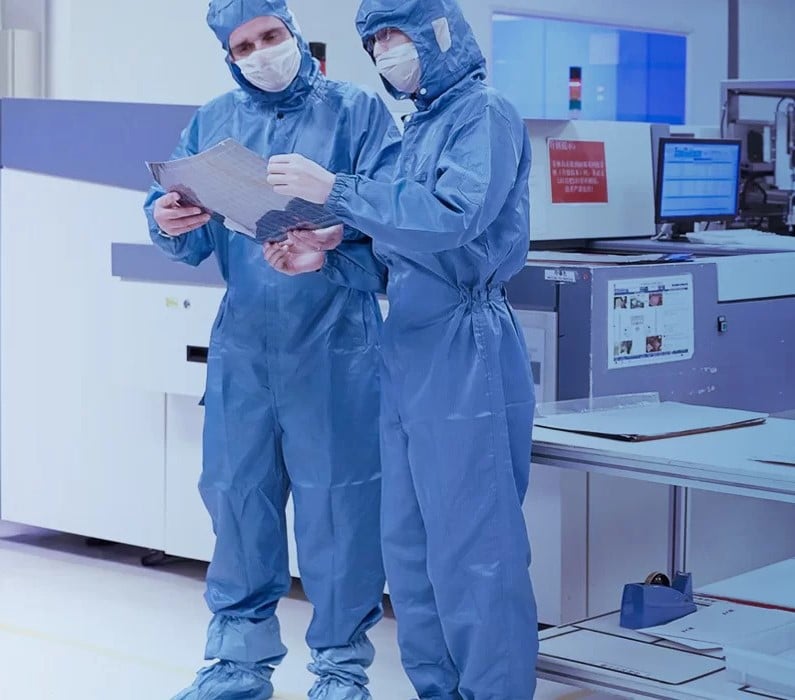
In pharmaceutical and sterile manufacturing environments, controlling contamination during material transfer is critical. Materials moving between different cleanroom areas can introduce microorganisms, particles, and other contaminants if the transfer process is not properly controlled.
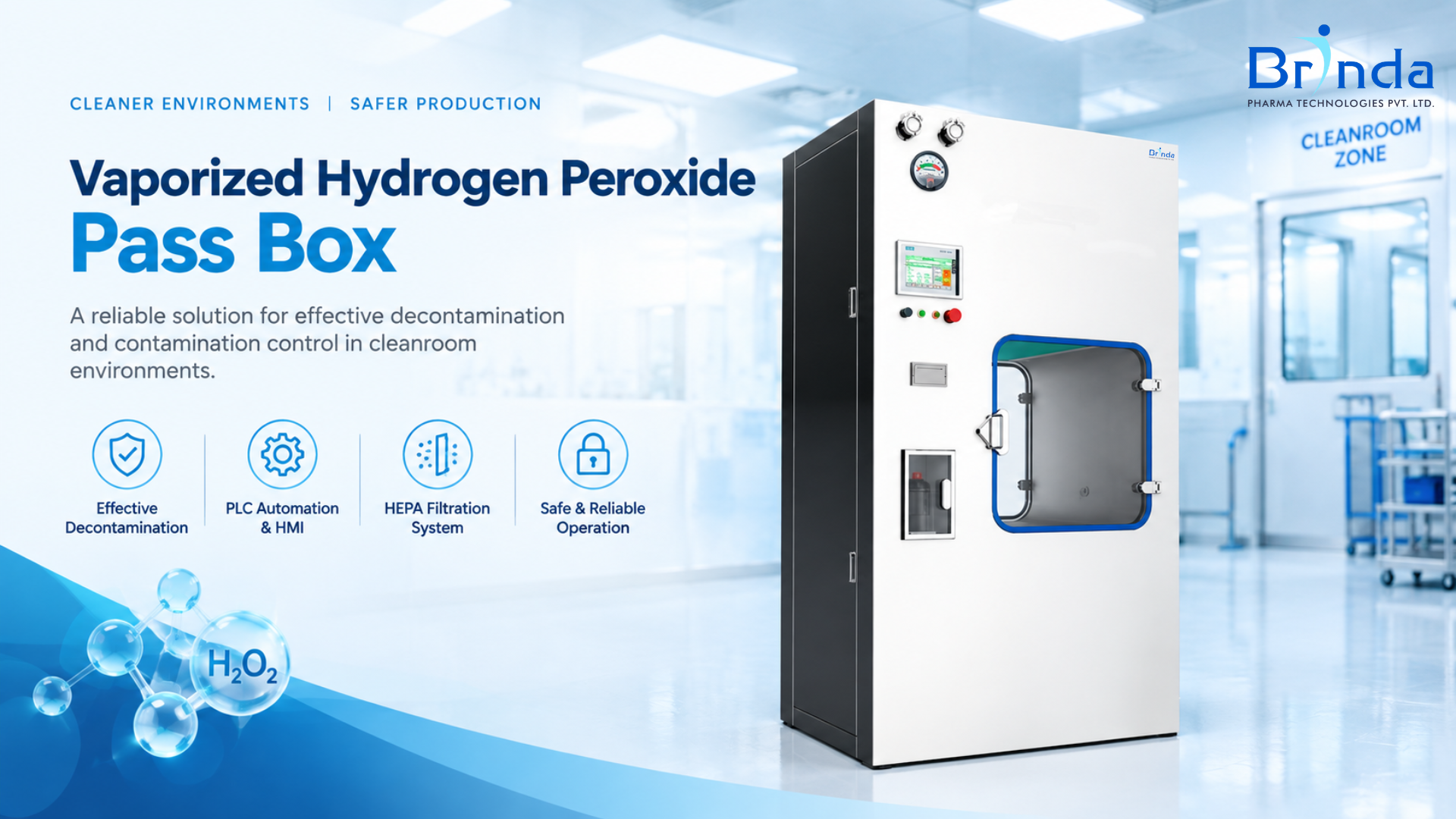
A VHP Pass Box provides a controlled solution for material transfer by combining a pass-through chamber with Vaporized Hydrogen Peroxide (VHP) decontamination technology.
Brinda Pharma Technologies Pvt. Ltd. designs and manufactures advanced VHP Pass Box systems for pharmaceutical, biotechnology, healthcare, research, and other controlled-environment applications. These systems can be configured with automation, controlled decontamination cycles, HEPA filtration, interlocked doors, HMI controls, and other features according to project requirements.
This guide explains what a VHP Pass Box is, how a VHP Pass Box works, its decontamination cycle, applications, components, validation requirements, and how to select the right system for your cleanroom.
A VHP Pass Box is a specialized cleanroom transfer chamber used to move materials between controlled areas while reducing the risk of contamination.
VHP stands for Vaporized Hydrogen Peroxide. In a VHP Pass Box, hydrogen peroxide is converted into a vapor and introduced into the enclosed chamber according to a controlled decontamination cycle.
The basic purpose of a VHP Pass Box for pharmaceutical manufacturing is to provide a controlled method of transferring materials while supporting contamination-control requirements.
A conventional pass box primarily provides a physical barrier between cleanroom areas. A VHP Pass Box adds a decontamination step to the material-transfer process.
A VHP Pass Box may be used when materials need to be transferred between areas with different cleanliness classifications and additional microbial decontamination is required.
Typical materials may include:
The VHP process can help reduce microbial contamination on compatible surfaces before material transfer.
The key difference is functionality.
A conventional Dynamic pass box provides controlled material transfer between rooms, whereas a VHP pass box incorporates a VHP-based decontamination process.
For facilities where material decontamination is an important part of contamination control, a VHP system can provide an additional level of process control.
Brinda Pharma offers VHP Pass Box solutions for pharmaceutical cleanrooms that can be designed according to the facility layout, chamber dimensions, material-transfer requirements, and automation requirements.
| The decontamination transfer chamber allow monitoring material, tools, or bags with stoppers etc. to be transferred quickly between cleanrooms of different classes – C, B or A according to cGMP. | ![]() |
| Fast and reliable microbiological surface decontamination is achieved using vaporized hydrogen peroxide (H2O2).The integrated LAF recirculation system guarantees the pressure cascade between the rooms and sterility is ensured also after the gassing process. | |
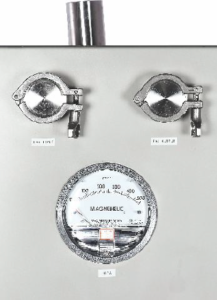
| All safety-relevant functions are constantly monitored electronically. |
The construction is created entirely in stainless steel AISI 316L, with a coarseness of Ra<0.6 for the processes surface parts and with materials compatible with vaporized hydrogen peroxide, for the other parts.
Toughened safety glass, T=15mm.
The inner room can be equipped as required with shelves, storage frames and trolleys.
| Dedicated electronics with an operating panel for the control of the pass box, in laminar flow functioning mode and in sterilization, the software is comprised of the following functions: | ![]() |
|
| As the most important requirement of traceability, a paperless recorder is used to record real time parameters, store parameters, and export data and other working conditions. | ![]() |
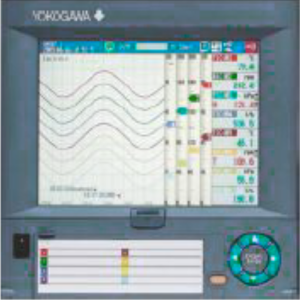
| Important parameters are monitored and may be recorded; they can be either directly sent to a printer (option) or stored on a remote PC (option). |
The chamber performs a separate fully automatic leak test prior to the decontamination cycle
Automatic leak testing procedure for the bio-decontamination airlock and for the whole work area.
At the beginning of each working routine the following steps will be automatically gone through.
According to ISO-14644-7 and ISO-10682-2 regulations, leakage tests are determined according to the requirements. An automatic leak test is carried out through PLC system, and clear results are obtained. If the technical requirements of leakage rate don’t meet the requirements, the subsequent transmission chamber cannot be sterilized.
Shut-off valves will be provided to permit leak testing by pressure decay. These valves will be fitted ahead of the inlet HEPA filters and after the exhaust HEPA filters.
| The open windows and doors are sealed by an inflatable seal, and the windows and doors are made of silicone rubber, which is certified by the pharmaceutical industry. | ![]() |
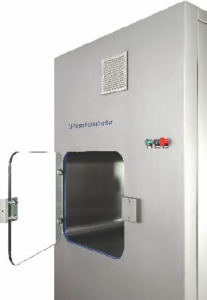
| When inflating, set pressure relief valve and pressure gauge to avoid the clean compressed air overcharging, when the pressure is insufficient, the alarm is carried out through the pressure gauge. | |
| When running, design the safety valve, keep the constant pressure of the inflatable seal ring, the seal pressure will be monitored at all times, and the alarm system is equipped. The mechanical parts that protect the window seal are also used to ensure the safety of the failure. |
| The door opening of the transmission and operation chamber is controlled. The operation log must be formed through the PLC system in order to open the door system. | ![]() |
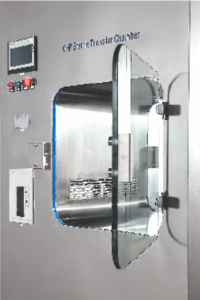
| When the door is opened or locked, transfer will not be able to enter the cabin run or, conversely, the same disinfection mode, when the transfer tank circulating disinfection, also cannot open the door. |
| The hydrogen peroxide generator is integrated with the chamber, vapors distribution and control system to provide automatic sporicidal gassing for the mode selected. It has the ability to use a number of different common bottle types, with the potential to execute dozens of cycles without the need for replenishment. | ![]() |
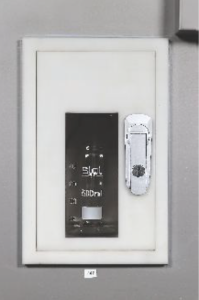
| The generator will be provided with the hydrogen peroxide sensor to measure the peak vapors concentration during the disinfection cycle. | |
The VHP sterilization cycle involves 4 phases:
The above steps are performed automatically through the transmission of the cabin PLC system without human interference. |
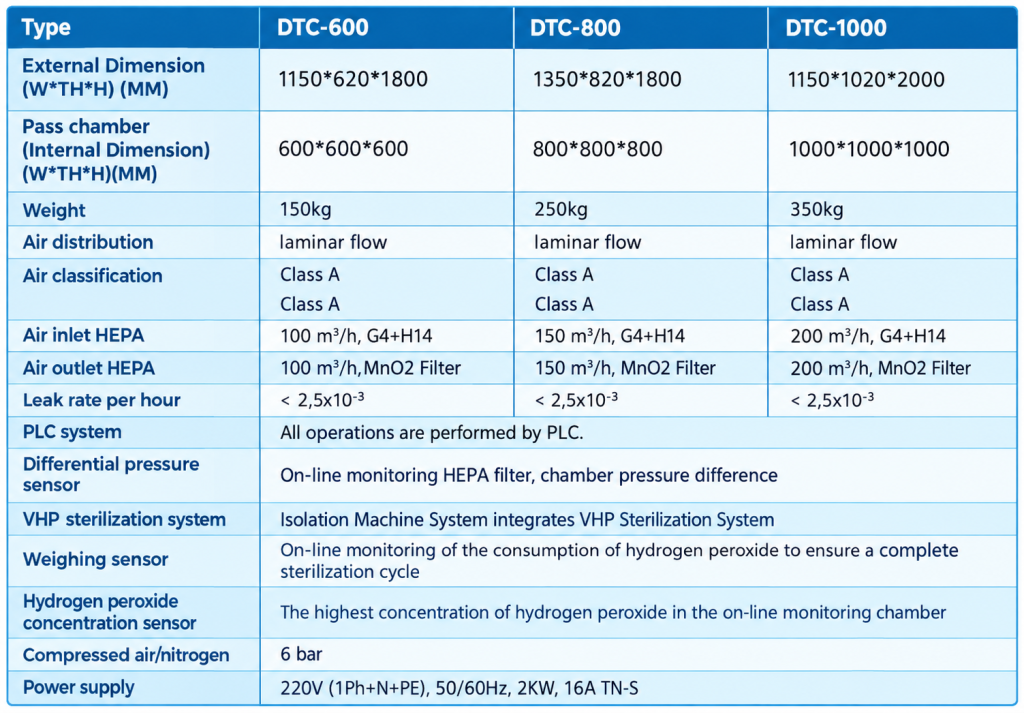
To comply with the requirement of the air quality inside the work chamber, High Efficiency Particulate Air Filter (HEPA) H14 are used. These filters act as a particle barrier between the isolator and the surrounding room. The air in the work chamber is double filtered.
The relative environment of the transfer chamber is a positive pressure system, and the air distribution is laminar flow. Fresh air is collected from the high level area (B level) or HVAC system, and the unidirectional laminar flow is formed through HEPA (H14).
The retention rate of H14 HEPA filter is according ISO14644: retention rate > 99.995% at 0.3 μm. The filter integrity test is done in compliance with ISO14644.
After the sterilization is completed, the automatic residue process is performed through the HMI, and the MnO₂ filter can effectively degrade the hydrogen peroxide and discharge the cavity.
316L Stainless Steel Loading ShelvesThe shelves are made of stainless steel 316L and are used for an efficient loading of the basic isolator. They are installed at the back wall of the work chamber. A shelf consists of 3 load surfaces with the dimensions 210 mm × 700 mm. The distance of a load surface between the top and the middle shelf is 140 mm, between the middle and the bottom shelf 250 mm. | ![]() |
Work Chamber Illumination SystemA fluorescent tube illuminates the work chamber and is placed on the outside of the front door and can be replaced during production. The color of the tube is daylight white. | |
H₂O₂ Concentration Monitoring System
|

Explore our complete range of Clean Room Equipment, Laboratory Furniture, Turnkey Projects, Process Equipment, and Packaging Machinery.

© Copyright Brinda Pharma Technologies 2026. All Rights Reserved
Error: Contact form not found.