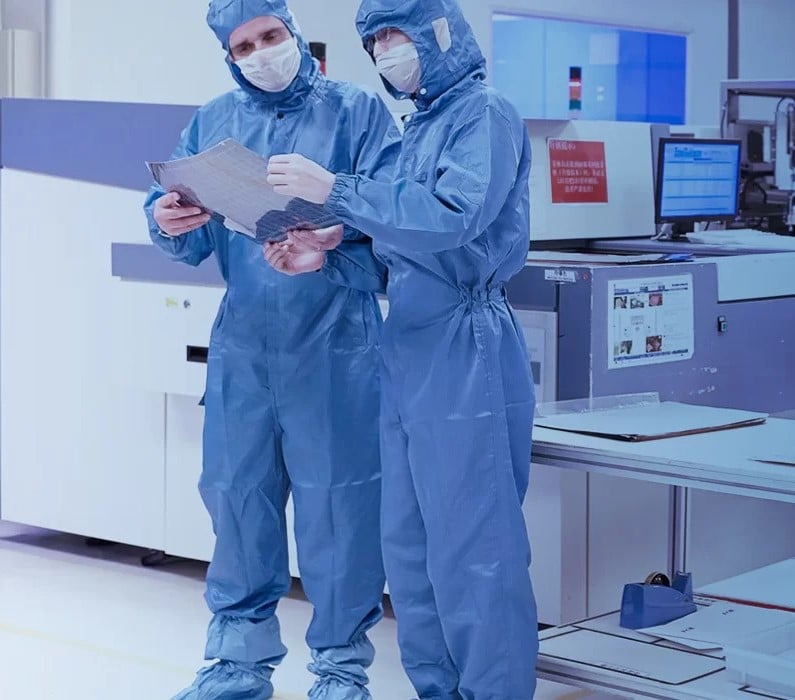

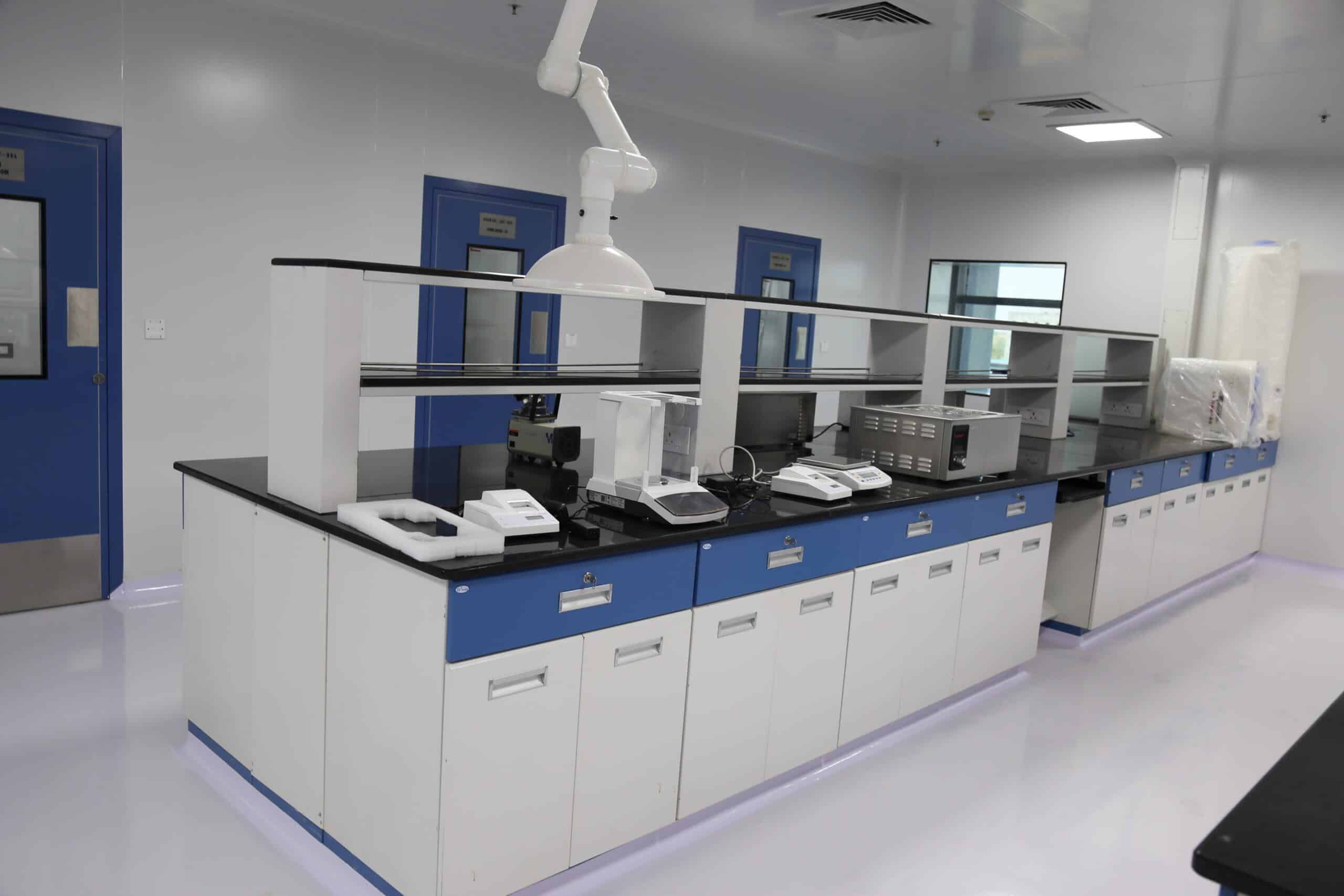
A clean room is a room where the concentration of particles is minimized. Temperature, humidity and pressure parameters are also controlled.
Operators use particular clothes (foot booties, coat, hairnet and gloves) to avoid dirtying the room.
Clean rooms are used for the industry or research fields, which are sensible domains to environmental contamination (biology, construction of spacecraft, optical manufacturing or semiconductors…).
To cope with rising demands of optics and space applications, an ISO 7 (class 10 000) clean room has been installed to minimize the presence of particles such as dust to enable the integration of “clean” and vacuum compatible hexapods.
In the space sector, we regularly deliver ISO 5 compatible systems, for which we follow the design and assembly rules related to the cleanliness of the ISO 5 environment.
A cleanroom or clean room is an engineered space, which maintains a very low concentration of airborne particulates. It is well isolated, well-controlled from contamination, and actively cleansed. Such rooms are commonly needed for scientific research, and in industrial production for all nanoscale processes, such as semiconductors & medicine manufacturing. A cleanroom is designed to keep everything from dust to airborne or vaporized particles, away from it, and so from whatever material is being handled inside it.
Cleanrooms typically come with a cleanliness level quantified by the number of particles per cubic meter at a predetermined molecule measure. The ambient outdoor air in a typical urban area contains 35,000,000 particles for each cubic meter in the size range 0.5 μm and bigger, equivalent to an ISO 9 certified cleanroom. By comparison an ISO 14644-1 level 1 certified cleanroom permits no particles in that size range, and just 12 particles for each cubic meter of 0.3 μm and smaller. Semiconductor facilities often get by with level 7, while level 1 facilities are exceedingly rare.
Some cleanrooms are kept at a positive pressure so if any leaks occur, air leaks out of the chamber instead of unfiltered air coming in. This is most typically the case in semiconductor manufacturing, where even minute amounts of particulates leaking in could contaminate the whole process, while anything leaking out would not be harmful to the surrounding community. The opposite is done e.g. in the case of high level bio-laboratories, handling contaminous viruses; those are always held at negative pressure, with the exhaust being passed through high efficiency filters, and further sterilizing procedures. Both are still cleanrooms, because the particulate level inside is maintained within very low limits.
Some cleanroom HVAC systems control the humidity to such low levels that extra equipment like air ionizers are required to prevent electrostatic discharge problems. This is a particular concern within the semiconductor business, because static discharge can easily damage modern circuit designs. On the other hand, active ions in the air can harm exposed components as well. Because of this most workers in high electronics and semiconductor facilities have to wear conductive boots while working. Low-level cleanrooms may only require special shoes, with completely smooth soles that do not track in dust or dirt. However, for safety reasons, shoe soles must not create slipping hazards. Access to a cleanroom is usually restricted to those wearing a cleanroom suit, including the necessary machinery.
In cleanrooms in which the standards of air contamination are less rigorous, the entrance to the cleanroom may not have an air shower. An anteroom (known as a “gray room”) is used to put on clean-room clothing. This practice is common e.g. in many nuclear power plants, which operate as low-grade inverse pressure cleanrooms, as a whole.
Recirculating cleanrooms return air to the negative pressure plenum via low wall air returns. The air then is pulled by HEPA fan filter units back into the cleanroom. The air is constantly recirculating and byu continuously passing thru HEPA filtration removing particles from the air each time. Another advantage of this design is air conditioning can be incorporated.
One pass cleanrooms draw air from outside the cleanroom, pass it thru HEPA fan filter units into the cleanroom. The air then leaves thru exhaust grills to outside the cleanroom. The advantage of this approach is the lower cost. The disadvantages are short HEPA fan filter live, worse particle counts than similar recirculating cleanroom, and cannot accommodate air conditioning.
| Class | Maximum particles/m3 | FED STD 209E equivalent | ||||||
| ≥0.1 µm | ≥0.2 µm | ≥0.3 µm | ≥0.5 µm | ≥1 µm | ≥5 µm | Cleanroom | ||
| Grade | ||||||||
| ISO 1 | 10 | |||||||
| ISO 2 | 100 | 24 | 10 | |||||
| ISO 3 | 1 000 | 247 | 102 | 35 | Class 1 | |||
| ISO 4 | 10 000 | 2 470 | 1020 | 352 | 83 | Class 10 | ||
| ISO 5 | 100 000 | 24 700 | 10 200 | 3 520 | 832 | Class 100 | A | |
| ISO 6 | 1 000 000 | 247 000 | 102 000 | 35 200 | 8 320 | 293 | Class 1 000 | B |
| ISO 7 | 352 000 | 83 200 | 2 930 | Class 10 000 | C | |||
| ISO 8 | 3 520 000 | 832 000 | 29 300 | Class 100 000 | D | |||
| ISO 9 | 35 200 000 | 8 320 000 | 293 000 | Room air |
| Grade | Maximum limits for total particle ≥0.5µm/m³ | Maximum limits for total particle ≥0.5µm/m³ | Maximum limits for total particle ≥5.0µm/m³ | Maximum limits for total particle ≥5.0µm/m³ |
|---|---|---|---|---|
| At rest | In operation | At rest | In operation | |
| A | 3,520 | 3,520 | Not specifieda | Not specifieda |
| B | 3,520 | 352,000 | Not specifieda | 2,930 |
| C | 352,000 | 3,520,000 | 2,930 | 29,300 |
| D | 3,520,000 | Not predeterminedb | 29,300 | Not predeterminedb |
Classification including 5µm particles may be considered where indicated by the CCS or historical trends.
b For grade D, in operation limits are not predetermined. The manufacturer should establish in operation limits based on a risk assessment and routine data where applicable.
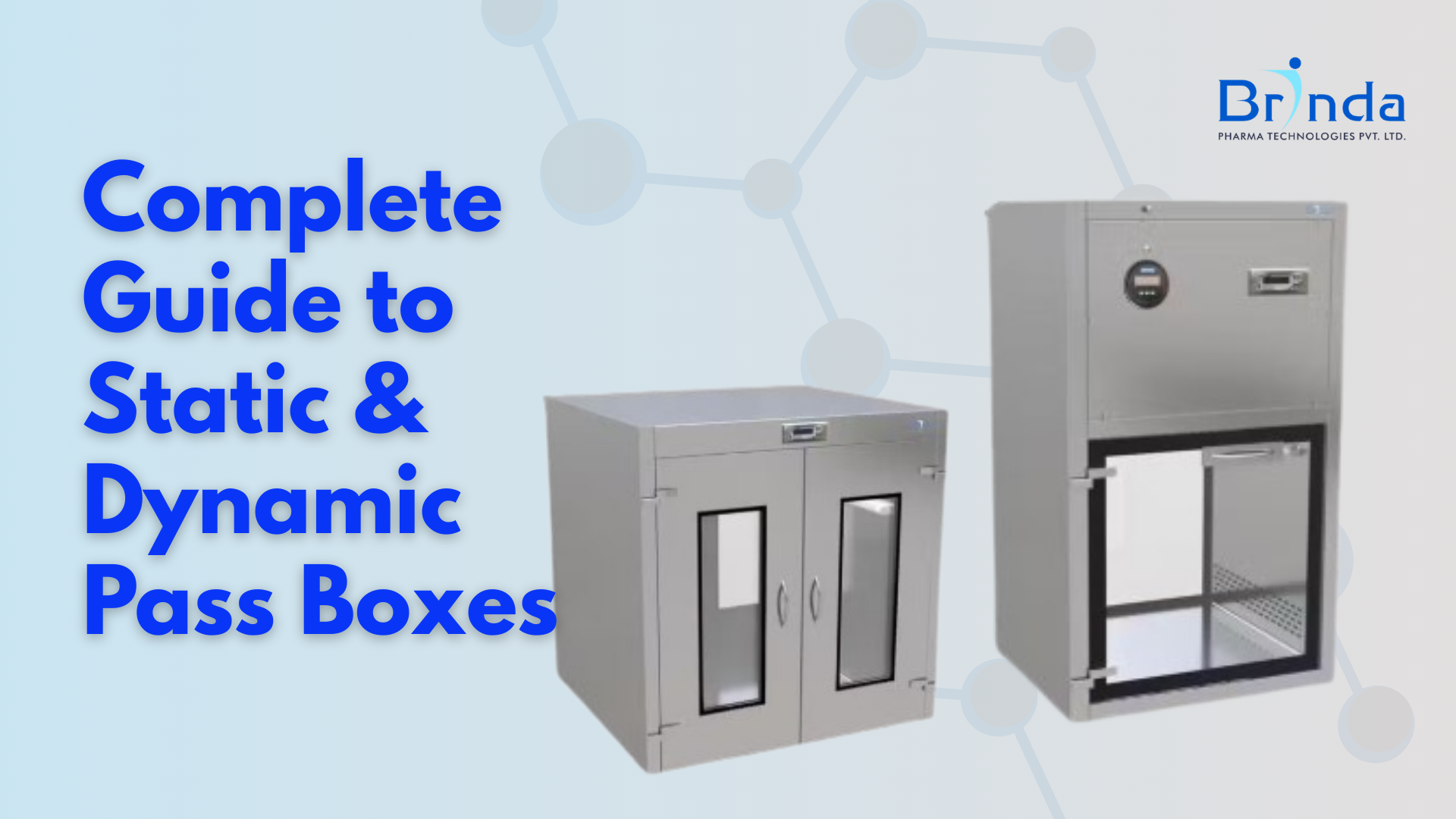
A Pass Box is a specialized cleanroom equipment used in pharmaceutical facilities to transfer materials between two controlled areas without allowing direct human movement between those areas. It helps maintain the cleanliness, sterility, and contamination control required in pharmaceutical manufacturing environments.
In pharmaceutical cleanrooms, maintaining strict hygiene and preventing contamination are critical for ensuring the quality and safety of medicines and sterile products. A pass box acts as a secure transfer chamber that allows items such as raw materials, tools, documents, or equipment to be passed from one room to another while minimizing the risk of contamination.
Brinda Pharma Technologies Private Limited designs and manufactures high-quality pass boxes that support contamination control and efficient material transfer in pharmaceutical cleanrooms and controlled environments.
A Static Pass Box is a cleanroom equipment used in pharmaceutical and biotechnology facilities to transfer materials between two areas with the same cleanroom classification while minimizing contamination risks. It acts as a sealed chamber installed in the wall between two controlled environments, allowing safe and efficient material transfer without direct personnel movement.
Static pass boxes are widely used in pharmaceutical manufacturing areas where airflow control is not required, but contamination prevention and cleanroom discipline are still important.
A Static Pass Box is a cleanroom equipment used in pharmaceutical and biotechnology facilities to transfer materials between two areas with the same cleanroom classification while minimizing contamination risks. It acts as a sealed chamber installed in the wall between two controlled environments, allowing safe and efficient material transfer without direct personnel movement.
Static pass boxes are widely used in pharmaceutical manufacturing areas where airflow control is not required, but contamination prevention and cleanroom discipline are still important.
Static pass boxes are commonly used in:
Advantages of Static Pass Boxes:
Brinda Pharma Technologies Private Limited manufactures high-quality static pass boxes designed to meet pharmaceutical cleanroom standards and ensure safe, contamination-controlled material transfer.
In summary, a static pass box is an essential cleanroom device that provides simple, reliable, and contamination-controlled transfer of materials between similar cleanroom environments in pharmaceutical facilities.
A Dynamic Pass Box is a cleanroom equipment used in pharmaceutical and biotechnology facilities to transfer materials between areas with different cleanroom classifications while maintaining strict contamination control. Unlike a static pass box, a dynamic pass box is equipped with an air filtration system, typically using HEPA filters, to ensure that the air inside the chamber remains clean during the material transfer process.
Dynamic pass boxes are commonly installed in critical pharmaceutical environments where maintaining high levels of cleanliness and sterility is essential.
A dynamic pass box operates with a built-in blower and HEPA filtration system that continuously circulates and filters air inside the chamber. The filtered air removes dust particles, microorganisms, and other contaminants, ensuring that materials remain clean during transfer.
The unit also includes an electromagnetic interlocking door system, which ensures that only one door can be opened at a time. This prevents air mixing between two areas with different cleanliness levels.
Key Features of a Dynamic Pass Box:
Applications in Pharmaceutical Facilities:
Advantages of Dynamic Pass Boxes:
Brinda Pharma Technologies Private Limited manufactures high-quality dynamic pass boxes designed to meet the strict contamination control requirements of pharmaceutical and biotechnology industries.
In summary, a dynamic pass box is an advanced cleanroom solution that ensures safe material transfer, air filtration, and contamination control between different cleanroom environments in pharmaceutical facilities.
Error: Contact form not found.
Error: Contact form not found.